
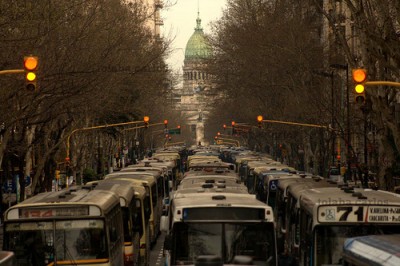
Buenos Aires has one of the most extensive public transportation networks in Latin America. Once you understand SUBE, colectivos, Subte and trains, the city becomes much easier—and much cheaper—to explore.
This guide is designed for international students and visitors who want to use the system like a local without memorizing every bus line before arrival.
The Four Main Ways to Get Around
- Colectivos: city buses that cover practically every neighborhood.
- Subte: the Buenos Aires subway, useful for fast trips across central corridors.
- Trains: suburban railways connecting the city with Greater Buenos Aires and useful day-trip destinations.
- Taxis and ride apps: useful late at night, with luggage or when public transport is inconvenient.
SUBE: The Transit Card You Should Know
SUBE is the traditional payment system for buses, trains and Subte. A physical card remains very useful for anyone living in Buenos Aires.
You can load a physical SUBE through the official app, electronic wallets, home banking, ATMs and physical points. Electronic loads may need to be accredited through the app, an automatic terminal or supported bus validators.
Open contactless payment has also expanded across Buenos Aires transport, including bank cards, NFC and QR options on supported validators. Because rollout and compatibility can vary, a SUBE card is still a practical universal backup.
How to Use a Buenos Aires Bus
Buses are called colectivos. At the stop, check the line number and direction. When the bus approaches, signal to the driver so it stops.
After boarding, tell the driver your destination or street intersection if the fare still depends on distance for that service, then pay at the validator. Navigation apps make the system dramatically easier than it once was.
Useful Bus Vocabulary
- colectivo — bus
- parada — stop
- línea — route/line
- ¿Me avisás cuando llegamos? — Can you tell me when we get there?
- ¿Este colectivo va a…? — Does this bus go to…?
Using the Subte
The Subte is often the fastest way to cross busy central areas. Lines are identified by letters and colors, and transfer stations are marked on system maps.
At all Subte stations, contactless payment options have expanded alongside SUBE. If you are staying for weeks or months, having SUBE plus a backup payment method gives you the most flexibility.
When Trains Are Useful
Trains matter more than many short-term visitors realize. They connect Buenos Aires with neighborhoods and destinations across the metropolitan area, and can be useful for trips toward Tigre and other areas outside the city center.
Check the current operator schedule before longer trips, especially on weekends or holidays when engineering works can alter service.
Google Maps, Cómo Llego and Route Planning
Modern route-planning apps remove much of the mystery from Buenos Aires buses. Compare two or three routes when possible: sometimes one direct colectivo is easier than a faster route involving multiple transfers.
Transport From EZE and AEP
Airport transportation is a separate decision. Ezeiza is well outside the city, while Aeroparque is inside Buenos Aires. Read our dedicated Buenos Aires Airport Guide before choosing a bus simply because it appears cheapest.
Public Transportation Safety
- Keep your phone secure near doors and open windows.
- Move backpacks in front of you on crowded vehicles.
- Do not block doors while checking directions.
- At night, compare the convenience of public transport with a direct ride.
- Keep a backup way to pay.
Frequently Asked Questions
Do tourists need a SUBE card?
Not every single trip requires one where open payment is available, but SUBE remains extremely useful for frequent public-transport use and broad network compatibility.
Can I pay Buenos Aires transport with a foreign card?
Contactless bank-card payment has expanded, but acceptance can depend on the mode and validator. Keep SUBE as a reliable alternative rather than depending on one foreign card.
Does Buenos Aires have a metro?
Yes. The subway is called the Subte.
What is the best transport for students?
Usually a combination: Subte for fast central corridors, colectivos for neighborhood-to-neighborhood trips and occasional taxis or ride apps late at night.
Learn the Network by Using It
You do not need to master Buenos Aires transportation before you arrive. Learn the route between your accommodation and classes first, then expand from there. Within a couple of weeks, the city map starts feeling much smaller.